Description
Chromatography Kit
Practical paper chromatography offers motivational learning opportunities, but relies on standard analytical grade papers or much less satisfactory alternatives such paper towelling.
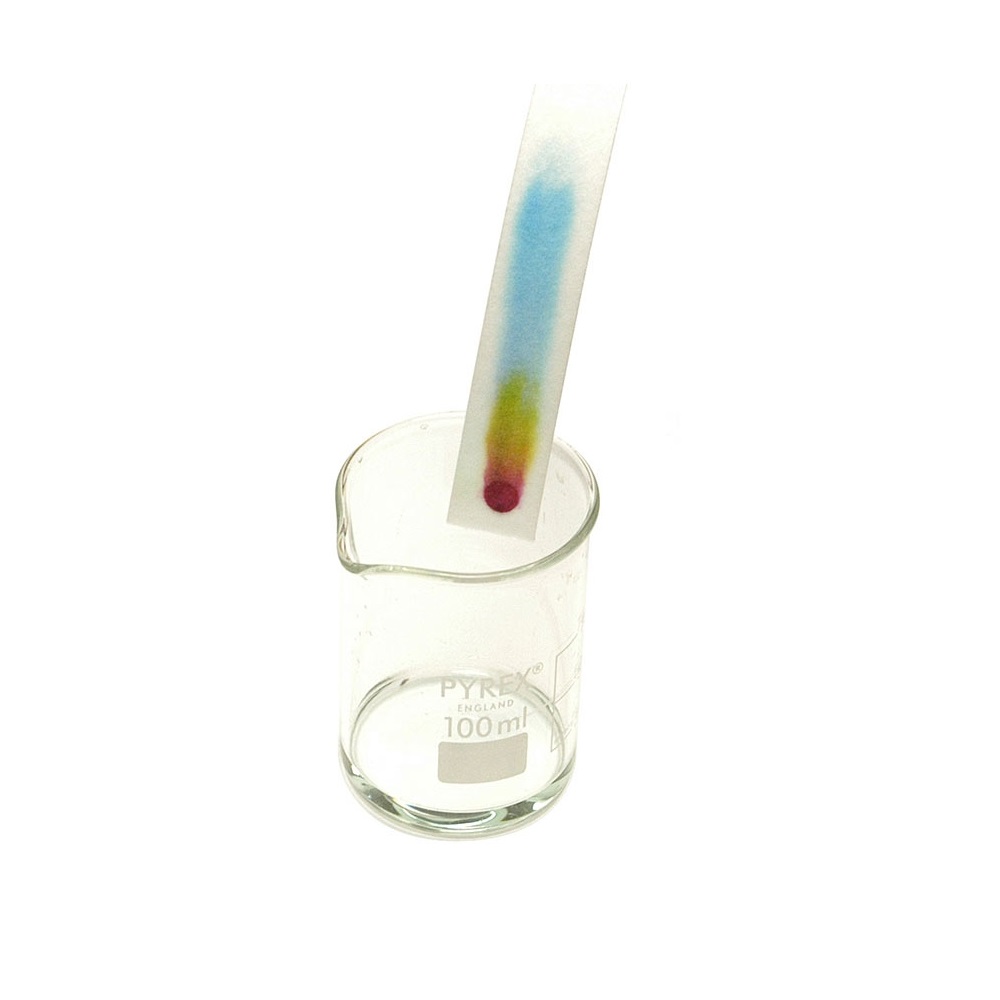
Using, for example, a mixture of CMY inkjet printer inks the card will produce a separation column up to 50mm in length in approximately 5 minutes. A whole class set of 100mm long spills can cost less than a single analytical grade equivalent spill
Applications include: basic chromatography separation, forensic techniques, stain diffusion patterning, colour diffusion patterning, records of chemical reactions, fluid syphoning – i.e., how to empty a cup with a bent wick!
The material is supplied in packs of 10 20x20cm sheets.
Paper chromatography
It is an
analytical method used to separate coloured chemicals or substances.
Erwin Chargaff credits in Weintraub’s history of the man the 1944 article by Consden, Gordon and Martin with sparking his discovery of
Chargaff’s rules, an important precursor to
Watson and Crick‘s discovery of the
double-helix structure of
DNA. For which they were awarded the
Nobel Prize in Physiology or Medicine in 1962.
It is now primarily used as a teaching tool, having been replaced in the
laboratory by other chromatography methods such as
thin-layer chromatography (TLC).
A paper chromatography variant,
two-dimensional chromatography involves using two solvents and rotating the paper 90° in between. This is useful for separating complex mixtures of compounds having similar polarity, for example,
amino acids. The setup has three components. The mobile phase is a solution that travels up the stationary phase, due to
capillary action. The mobile phase is generally a mixture of non-polar organic solvent, while the stationary phase is polar inorganic solvent water. Here paper is used to support the stationary phase, water. Polar water molecules are held inside the void space of the cellulose network of the host paper. The difference between
TLC and paper chromatography is that the stationary phase in TLC is a layer of adsorbent (usually
silica gel, or
aluminium oxide), and the stationary phase in paper chromatography is less absorbent paper.